_2.png)
 Request a Call
How much chlorine is needed to treat water? How much chlorine bleach do I put in my water tank?
For a 50 PPM shock, add about 2½ to 3⅓ quarts of today’s 6% to 8.25% household bleach per 1,000 gallons of water, leave it at least 12 hours, preferably 24 (never longer than 36 hours), then flush until a test shows no chlorine. (The old rule of 1 gallon per 1,000 gallons assumed 5.25% bleach and now gives roughly 60–80 PPM.) Use the calculator below for your exact tank.
Work Out How Much Chlorine to Add
How much chlorine do I need?
Enter your tank size, or your well casing and water depth, and get the exact amount of bleach or dry chlorine to add.
Use NSF/potable-grade calcium hypochlorite. Do not use pool Tri-Chlor tablets or stabilized pool chlorine.
Check the bottle before you measure. Household bleach is no longer a single strength — it now runs from about 6% to 8.25% sodium hypochlorite, and the percentage is printed on the label. Use fresh, plain, unscented liquid bleach. Avoid scented, splashless, color-safe and gel bleach, which contain thickeners and additives that do not belong in drinking water.
Add this much liquid chlorine
—
What to do with it
Before you start. Bypass the softener, filters and any other treatment equipment. Wear goggles and gloves, and keep the area ventilated — chlorine fumes in an enclosed well house or tank can be dangerous. Never pour chlorinated water into a septic system, onto plants, or into a creek or pond.
What you need on hand
Shock chlorination only tells you something if you can measure the result. A high-range kit confirms you actually hit your target and reads correctly while levels are still high; a low-range kit tells you when the chlorine is truly gone. You want both — a low-range kit alone can read zero on water that is still heavily chlorinated. If bacteria come back after two or three weeks, the source needs continuous disinfection rather than another shock.
The high-range kit reads to 80 ppm. If you dosed to 100 ppm it will be over range at first, which is itself useful information — it tells you the chlorine is there and working. It comes into range as the chlorine is consumed and drops, which is when you actually want the number.
Why we ask what strength your bleach is
Chlorine bleach is not all the same strength, and the amount you need depends entirely on which one is in your hand. Household bleach sold today generally runs between 6% and 8.25% sodium hypochlorite. Liquid pool chlorine is roughly twice as strong, at 10% to 12.5%. You will also see 5.25% quoted in older references and on some product labels, which was the common household strength for many years.
The percentage is printed on the bottle. Check it before you measure, and set it in the calculator — that one number is the difference between hitting your target and missing it. Dry chlorine is different: potable-grade calcium hypochlorite pellets and granules are a fixed 70% strength, so there is no percentage to set for them.
Two other things affect what you are actually adding. Bleach loses strength on the shelf, so a jug that has been in the garage since last summer is weaker than the label says; buy fresh for a job like this. And use plain, unscented liquid bleach only. Scented, splashless, color-safe and gel bleaches contain thickeners and additives that have no place in drinking water.
Chlorine demand, and why your residual drops
The numbers above are what it takes to reach your target in clean water. Iron, manganese, sulfide, tannins and organic matter all consume chlorine on contact — that consumption is called chlorine demand, and it is the reason a well that tested at 100 ppm in the morning reads 20 ppm by evening.
This is why the test kit matters more than the calculation. Measure the residual after the contact time. If it has fallen well below your target, the demand was higher than the dose and the job needs repeating.
Read a zero with suspicion while chlorine could still be high. Above about 10 ppm, chlorine bleaches the reagent rather than coloring it, and the result looks like no chlorine at all. Dilute the sample with equal parts chlorine-free water, retest and double the reading, or use a high-range kit.
Before You Dose: Clean and Inspect the Tank
Step 1: Clean The Storage Tank First
Clean the storage tank or reservoir. Remove debris and scrub or hose off any dirt or other deposits or interior surfaces. Pump to remove any suspended solids or foreign matter in the water if possible.
Step 2: Use Strong Chlorine Solution
If possible, scrub the interior surfaces of storage or reservoir if applicable with a strong chlorine solution containing ½ gallon of household bleach, or ¼ gallon of pool chlorine to every 5 gallons of water.
Make sure there is adequate ventilation. Enclosed spaces are dangerous and can cause illness or death.
Step 3: Inspect For Damages
Inspect the storage tank for cracks, leaks around the lid or man-way, or vents. Make sure no insects, rodents, or other debris can enter the tank during normal operation of the tank and water system, by making sure the lid is tight-fitting, and any vents are properly screened.
Two Methods: Shock Chlorination Or Chlorine Maintenance Residuals
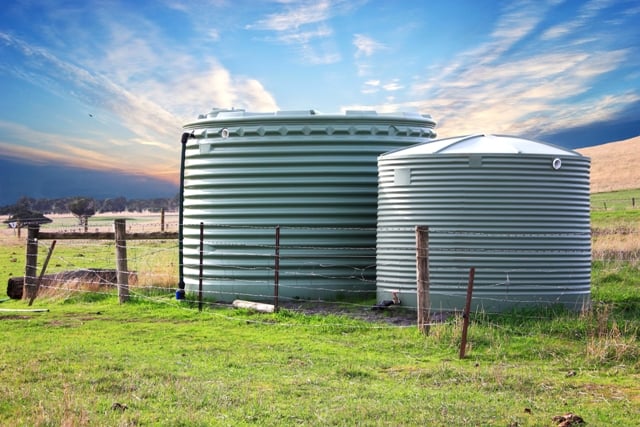 Chlorine is an effective and low-cost chemical for disinfecting water storage tanks but we are often asked how much to add to a storage tank to kill bacteria.
Also known as ‘chlorine shock”, this article can show you how much chlorine shock to use. To do a chlorine shock you can use liquid chlorine (bleach) or granular chlorine.
Using the calculator above you can find out how much Chlorine Bleach is needed to disinfect and purify specific quantities of water, for example, 1,000 gallons or 1,000 litres. Whether you have a 350 gallon tank, a 600 gallon tank, a 1000 gallon tank, a 1,000 litre IBC tote or a 5,000 litre rainwater tank, it is easy to know how much to add to your water storage tank.
On this page, we will talk more about the chlorine-to-water ratio and how much chlorine to put in drinking water.
If your water storage tank is new, has been worked on recently, or you know it is contaminated, perform a “shock chlorination” with 50 to 100 parts per million (PPM). Let it stand at least 12 hours, preferably 24. Don’t leave it in the system longer than 36 hours.
After you add the chlorine, the chlorine levels will start to drop. Chlorine is used up and breaks down depending on the chlorine demand (your water’s chemistry and conditions) and the temperature of the water.
Test the chlorine residual after 24 hours and if the chlorine levels are 10 PPM or less, repeat the procedure. If you are storing water and want to keep a chlorine residual to be safe, use a maintenance residual of 1 – 2 PPM.
Shock Chlorination
Shock chlorination adds chlorine until the residual reaches 50 to 100 PPM. This is recommended when you have a new storage tank or have work done on the well, or find out the storage tank is contaminated with coliform bacteria.
Shock chlorination will make the water unusable for potable use until the chlorine has been flushed out completely and a test shows no chlorine at all, which typically takes a few days to a few weeks depending on temperature and water chemistry.
Maintenance or Low-Level Chlorination
Don’t want to use shock chlorination? It is best to use an automatic chlorinator if you wish to automatically maintain a chlorine residual to keep your storage tank disinfected as freshwater flows into it.
However, if your storage tank is for long-term storage or you wish to periodically chlorinate, use the calculator above and choose 1 or 2 PPM.
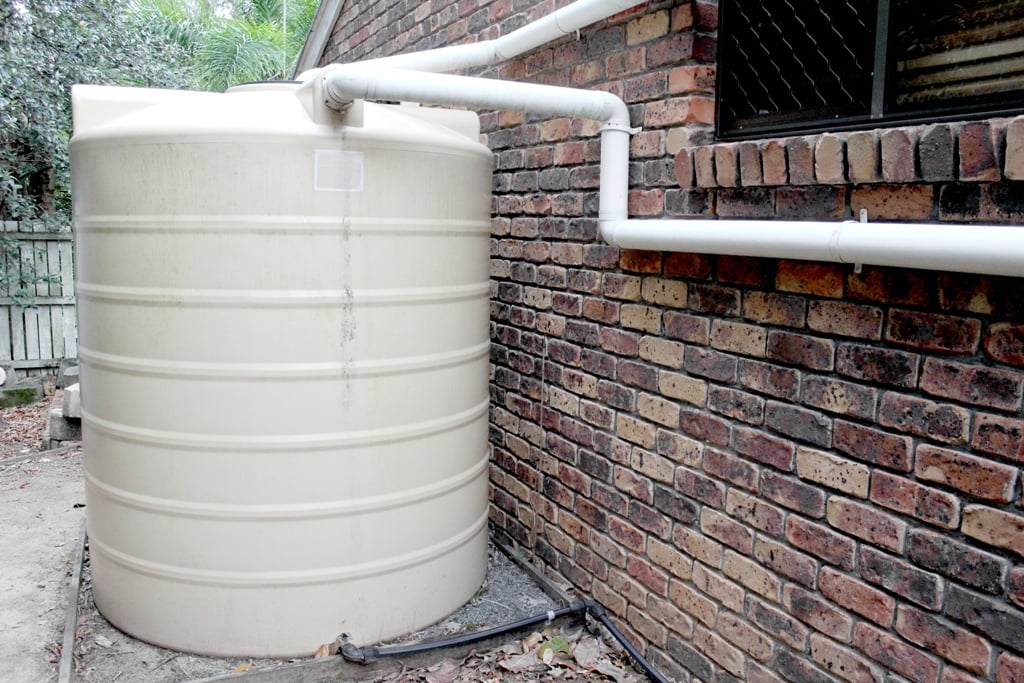
A chlorine residual of 1 to 2 PPM is recommended if you plan to maintain a chlorine residual for potable water use. Use the calculator above to find out how much chlorine bleach to add to achieve these residuals.
NOTE: If you need to use the water in the tank immediately after chlorination, consider adding enough chlorine to bring the levels up to 5 or 10 ppm and let it stand at least 12 hours. Use the 50 or 100 PPM settings only if you are doing shock chlorination for new or heavily contaminated storage tanks.
Storage tanks: Disinfecting with liquid household bleach (6% Sodium Hypochlorite) — quick reference
Every column in these charts assumes 6% household bleach. If your bottle says anything else — 5.25%, 7.5%, 8.25%, or 10 to 12.5% pool chlorine — use the calculator above for the exact amount.
| Storage Tank Gallons | Approx. parts per million of chlorine residual achieved by adding 6% household bleach, in the amounts below. Numbers are rounded for easier measuring. | |||||
| 1 PPM with 6% bleach | 5 PPM with 6% bleach | 10 PPM with 6% bleach | 50 PPM with 6% bleach | 100 PPM with 6% bleach | ||
| 10,000 | 2.7 cups | 3.3 quarts | 1.7 gallons | 8.3 gallons | 17 gallons | |
| 5,000 | 1.3 cups | 1.7 quarts | 3.3 quarts | 4.2 gallons | 8.3 gallons | |
| 2,500 | 5.3 fl oz | 3.3 cups | 1.7 quarts | 2.1 gallons | 4.2 gallons | |
| 1,500 | about 6 tablespoons | 2 cups | 1 quart | 1.3 gallons | 2.5 gallons | |
| 1,000 | about 4 tablespoons | 1.3 cups | 2.7 cups | 3.3 quarts | 1.7 gallons | |
| 500 | about 2 tablespoons | 5.3 fl oz | 1.3 cups | 1.7 quarts | 3.3 quarts | |
| 250 | about 1 tablespoon | about 5 tablespoons | 5.3 fl oz | 3.3 cups | 1.7 quarts | |
| 100 | 1.3 teaspoons | about 2 tablespoons | about 4 tablespoons | 1.3 cups | 2.7 cups | |
| Storage Tank Litres | Approx. parts per million of chlorine residual achieved by adding 6% household bleach, in the amounts below. mL = millilitres. | |||||
| 1 PPM with 6% bleach | 5 PPM with 6% bleach | 10 PPM with 6% bleach | 50 PPM with 6% bleach | 100 PPM with 6% bleach | ||
| 10,000 | 167 mL | 833 mL | 1.7 litres | 8.3 litres | 17 litres | |
| 5,000 | 83 mL | 417 mL | 833 mL | 4.2 litres | 8.3 litres | |
| 2,500 | 42 mL | 208 mL | 417 mL | 2.1 litres | 4.2 litres | |
| 1,000 | 17 mL | 83 mL | 167 mL | 833 mL | 1.7 litres | |
| 500 | 8.3 mL | 42 mL | 83 mL | 417 mL | 833 mL | |
Drain and Flush the Tank
Drain and flush the tank if using these higher levels of chlorine. Don’t put water with chlorine residual into drains leading to septic tanks, and avoid discharge into creeks, rivers, or lakes.
Be careful if you have a steel storage tank, as corrosion may have occurred over time, and once the tank is cleaned it may develop leaks.
A general rule of thumb to shock chlorinate and disinfect a storage tank: with non-scented NSF-approved 5.25% household bleach, 1 gallon of bleach for every 1,000 gallons of water (i.e., 1 quart for every 250 gallons of water) gives about 50 ppm. Most household bleach sold today is stronger, 6% to 8.25%, so the same gallon gives roughly 60 to 80 ppm. Check the strength on your bottle and use the calculator above.
That is far higher than the 0.5 to 2.0 PPM found in treated city water, and it makes the water unusable for potable use until the chlorine has been flushed out completely and a test shows no chlorine at all.
For storage tanks or cisterns fed by well water: Add bleach directly to the storage tank at the same time, you are disinfecting the well. Let the storage tank drain into the distribution system. For the well itself, see how to shock chlorinate a well.
After it has stood at least 12 hours, preferably 24 (never longer than 36 hours), drain the storage tank through a drain valve or through the distribution system.
Do not dispose of chlorinated water into a septic tank or on vegetation or into surface water.

If you cannot find NSF-certified chlorine bleach use NSF-certified chlorine pellets or powder.
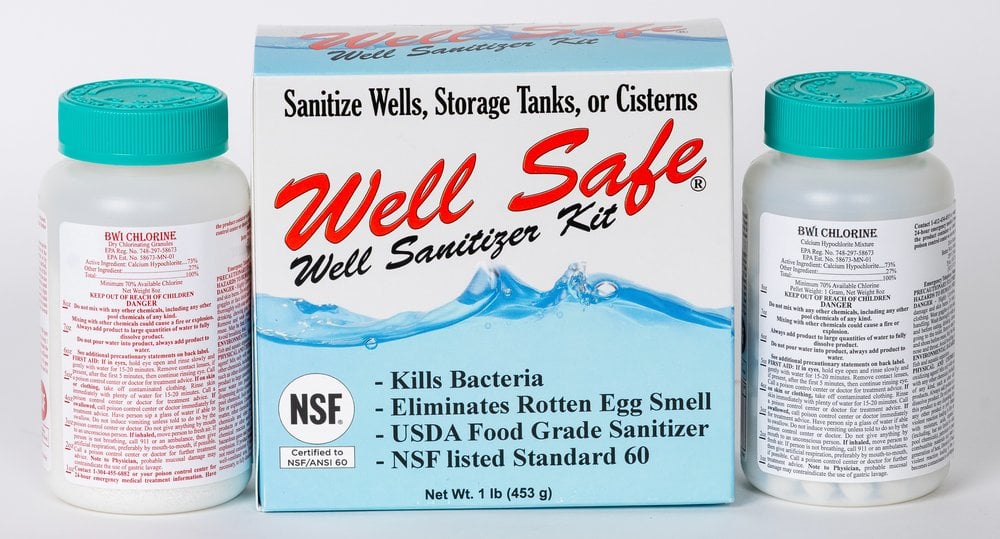
Click to see Well Safe Sanitizer Kit.
Using Calcium Hypochlorite Granular or Pellets
Storage tanks: disinfecting with dry chlorine pellets or chlorine granules (the calculator above shows the dry amount too). Do not use dry pool chlorine. Use calcium hypochlorite for potable water.
What Type of Chlorine Is Best to Use?
Besides knowing how much chlorine to put in water storage tank, you also need to decide on which type of chlorine to use.
There are three main types of bleach available to use to sanitize your water storage tank.
The worst option is to use household laundry bleach, Clorox. This contains unwanted chemicals besides chlorine. Laundry bleach does work and will disinfect your storage tank, so that is an option. Make sure to use non-scented.
The best chlorine bleach is certified for drinking water. If you cannot find liquid bleach that is NSF certified, you can use dry NSF pellets or powdered bleach.
A second good option is to use liquid pool chlorine, which is sodium hypochlorite without additives (unlike laundry bleach). You can usually find liquid pool chlorine at Home Depot, Lowe’s, hardware stores, and also spa and pool supply companies. Pool chlorine is liquid 10-12.5% sodium hypochlorite, which means it has 10 to 12.5% chlorine.
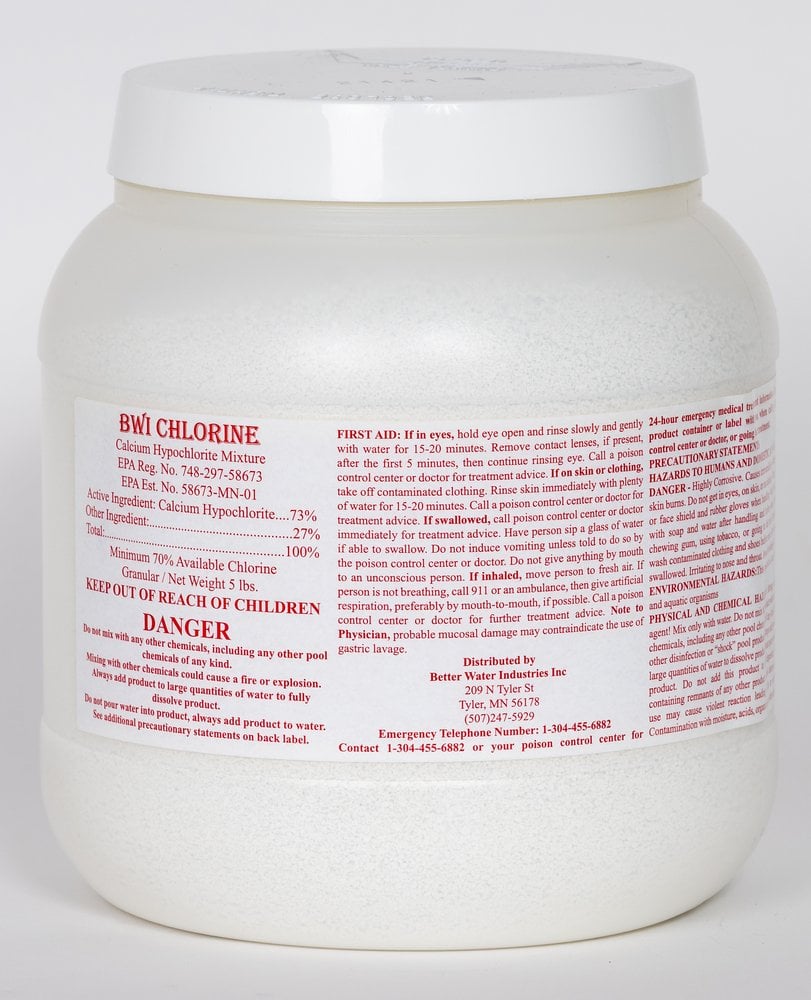
An easy-to-use NSF-certified chlorine bleach is chlorine granules with no additives. This type is calcium hypochlorite and can be mixed with warm water and put into storage tank.
Do not use dry powdered pool chlorine, sometimes known as Tri-Chlor, in your storage tank or well water.
Which Chlorine Test Kit Should I Use?
After you figure out how much chlorine to put in water storage tank, you may want to have a chlorine test kit on hand to know the chlorine residual after you have chlorinated your storage tank.
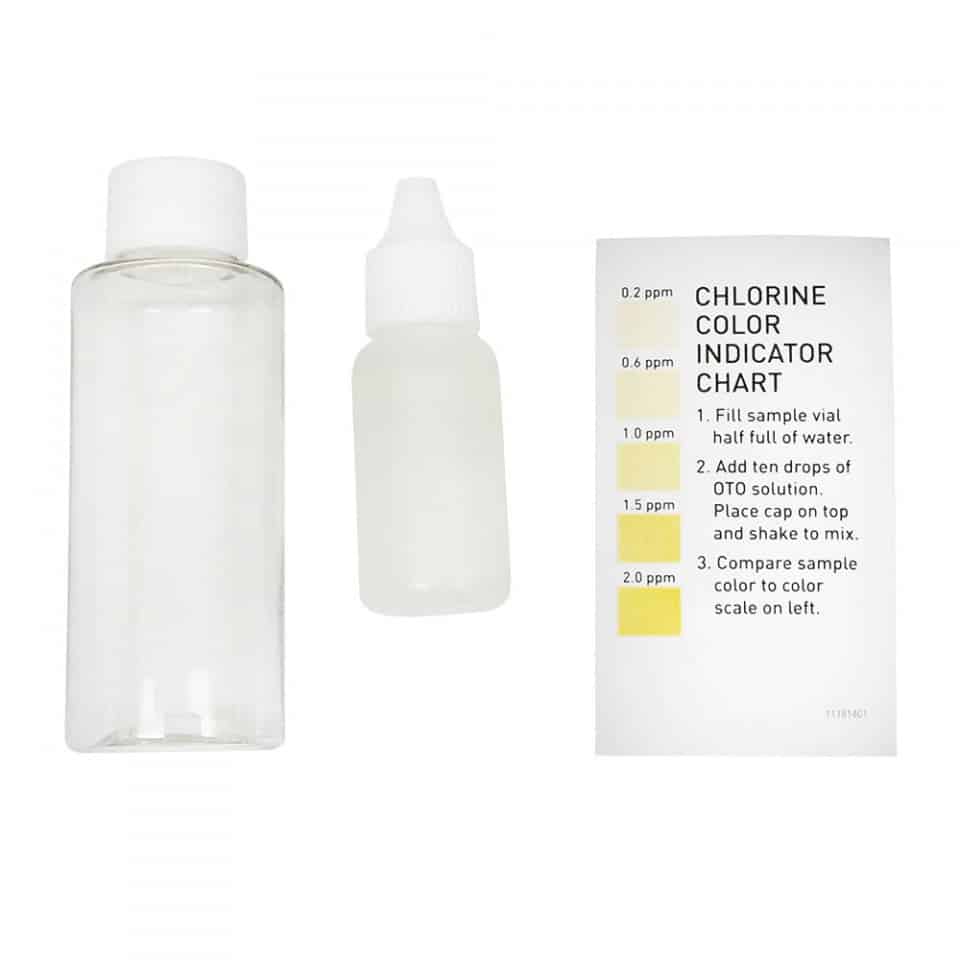
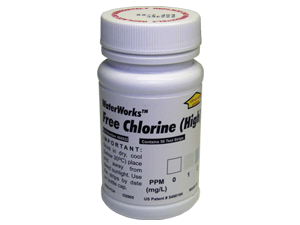
Having test kits offers two main benefits:
- You can tell if you have added sufficient chlorine to your tank because you can measure the chlorine levels.
- You can confirm the chlorine is completely gone before you use the water in the home again.
There are two main types of chlorine test kits for easy home use, and they are liquid drop types (which use reagents that you drop into a test tube) and test strips.
A common low-range chlorine test kit uses Orthotolidine, which turns yellow if chlorine is present, so it is easy to use.
Test strips are easier to use but for low range, the reagent type may work better in our experience.
You also may want a High Range Kit if you are “shock chlorinating” the tank with high levels of chlorine over 5 PPM.
A low range kit allows you to check for chlorine levels if you are adding chlorine to maintain a low level residual, or you want to know when it is safe to use the water.
Is Chlorine Dangerous or Bad for My Health?
According to the CDC and other health authorities, chlorine levels up to 4 milligrams per liter (mg/L or 4 parts per million (ppm)) are considered safe in drinking water. At this level, harmful health effects are unlikely to occur. That limit covers the low, steady chlorine levels a water utility maintains. It is not a target for flushing out a shock dose: after shock chlorination, flush until a test shows no chlorine at all.
There are studies that show that showering and drinking chlorinated water over your lifetime may increase your chance of getting some cancers, however adding chlorine to kill bacteria in your storage tank and then draining the water out will not have any health effects.
In municipal treatment plants, chlorination is the process of adding chlorine to drinking water to kill parasites, bacteria, and viruses. Different processes can be used to achieve safe levels of chlorine in drinking water. Using or drinking water with small amounts of chlorine does not cause harmful health effects and provides protection against waterborne disease outbreaks.
Water comes from a variety of sources, such as lakes and wells, which can be contaminated with germs that may make people sick. Germs can also contaminate water as it travels through miles of piping to get to a community. To prevent contamination with germs, water companies add chlorine to keep water safe.
Liquid bleach and chlorine powders and pellets can be hazardous to work with unless you use some common sense precautions. Use gloves and eye protection and avoid breathing chlorine fumes or exposing your skin to chlorine.
Does Chlorine Kill All Bacteria?
The Efficacy of Chlorine in Water Treatment: Chlorine is a powerful disinfectant widely used in water treatment to eliminate harmful bacteria and other microorganisms. Its effectiveness is attributed to its ability to disrupt the cell walls of bacteria, rendering them harmless. This makes chlorine a critical component in ensuring water safety, especially in storage tanks.
Chlorine Concentration and Safety: As we noted earlier, it is critical to achieve the appropriate chlorine concentration, typically between 1 and 2 parts per million (PPM), for potable water. This concentration is effective in killing bacteria while remaining safe for human consumption. However, it’s essential to balance the dosage and contact time correctly. For example, shock chlorination, which uses a higher chlorine concentration (50 to 100 PPM), is recommended for treating new or contaminated tanks but requires the chlorine to be flushed out completely before the water becomes potable again.
Limitations of Chlorine in Achieving Sterility: While chlorine is effective in killing bacteria, it’s important to note that the treated water is not rendered sterile. To achieve water that is completely free of bacteria, additional purification steps are necessary after chlorination. These steps can include methods like ultraviolet sterilization, which uses UV light to further disinfect the water, or advanced filtration techniques.
Advanced Filtration Techniques: Filtration methods such as using a nano-ceramic filter cartridge or an ultra-filtration membrane can effectively remove any remaining microorganisms from the water. These methods work by physically filtering out bacteria and other pathogens, providing an additional layer of safety and ensuring that the water is as free from bacteria as possible.
What about Hydrogen Peroxide? Can I Use Peroxide Instead of Chlorine?
You might wonder if peroxide can be used instead of chlorine to sanitize your storage tank but this won’t work.
You can use hydrogen peroxide on cuts or abrasions to kill germs but it is not a good disinfectant for drinking water. Hydrogen peroxide is rarely used in drinking water as a stand-alone treatment process. It’s a very weak biocide compared to chlorine or ozone.
It’s not approved by the EPA and other health authorities as a stand-alone disinfection treatment process. Hydrogen peroxide is great for removing odors and making water taste better but it is not useful for the disinfection of storage tanks.
Resources:
Learn more about when to disinfect a well at WellOwner.org and refer to their homeowner’s checklist for well maintenance.
Clean Water Store. (n.d.). How to use chlorination systems for well & spring water. https://www.cleanwaterstore.com/resource/how-to-guides/how-to-use-chlorination-systems-for-well-spring-water/

Frequently Asked Questions (FAQs)
1. How much chlorine do I need to disinfect a water tank?
The amount depends on tank size, the chlorine level you want and the strength of your bleach, so use the calculator above. As a guide, 1 gallon of 5.25% bleach in 1,000 gallons of water gives about 50 PPM; today’s 6% to 8.25% household bleach needs about 0.6 to 0.85 gallon for the same result. For 1,000 litres of drinking water, 50 PPM takes about 833 mL of 6% bleach, and a 1–2 PPM maintenance level takes about 17 to 33 mL.
2. What is shock chlorination, and when should I use it?
Shock chlorination involves adding enough chlorine to raise levels to 50–100 PPM. Use it for new tanks, post-maintenance, or when contamination is detected.
3. Can I use regular household bleach to disinfect my tank?
Yes, if it’s plain, unscented liquid bleach. Check the strength on the label (usually 6% to 8.25% now) and enter it in the calculator. Avoid scented, splashless, color-safe and gel bleaches.
4. What’s the difference between shock chlorination and maintenance chlorination?
Shock chlorination is a one-time high dose for disinfection. Maintenance chlorination keeps chlorine at 1–2 PPM to prevent contamination over time.
5. How long should I wait after chlorinating before using the water?
Let it stand at least 12 hours, preferably 24, and never longer than 36 hours, then flush until a test shows no chlorine at all. Depending on water chemistry and temperature, that can take a day or several weeks.
6. Can I use chlorine pellets or granular calcium hypochlorite instead of bleach?
Yes. Dry chlorine is effective and ideal for potable water. The calculator above shows the dry amount as well.
7. How do I test if my tank has the right chlorine level?
Use chlorine test kits or strips to check residual levels. A high-range kit confirms you reached your shock level; a low-range kit confirms when the chlorine is completely gone. A low-range kit alone can read zero on heavily chlorinated water.
8. Is chlorinated water safe to drink?
After shock chlorination, only once it has been flushed until a test shows no chlorine at all. Water held at a 1–2 PPM maintenance level is safe to drink. The 4 PPM figure you may see quoted is the ceiling for public water systems, not a target for flushing out a shock dose.
9. Does chlorine kill all bacteria in the tank?
Chlorine is effective against most bacteria but doesn’t sterilize the water. For full sterilization, consider UV or additional filtration.
10. Can I use hydrogen peroxide instead of chlorine?
No. Hydrogen peroxide is not EPA-approved as a stand-alone disinfectant for potable water and is not suitable for tank sanitization.


